



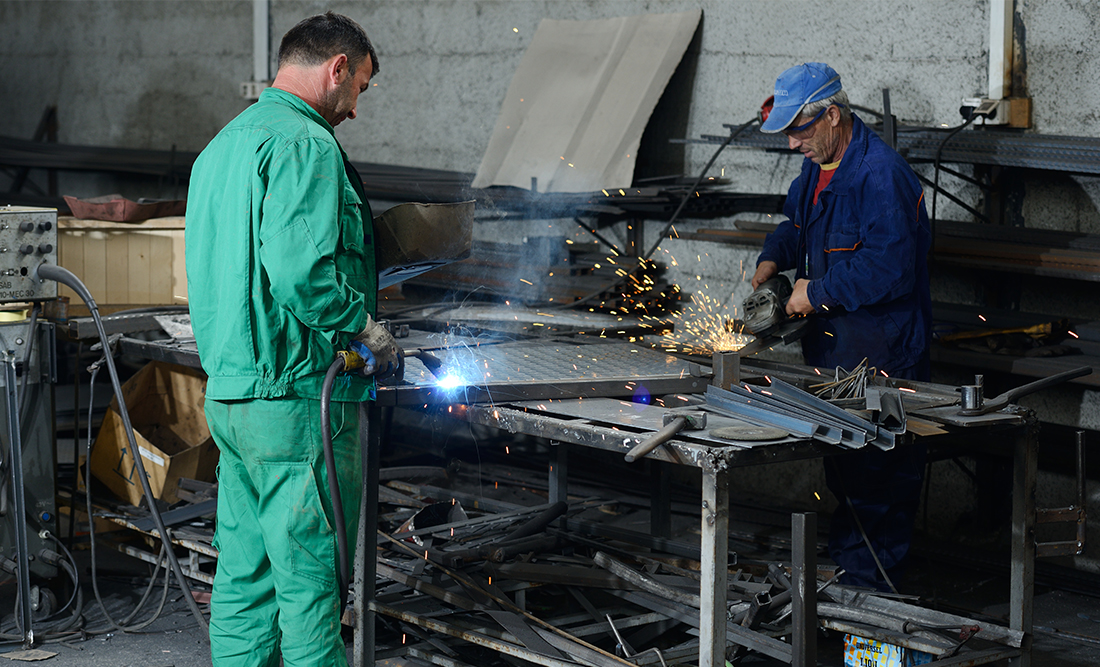
Metalworking is the process of working with metals to create individual parts, assemblies, or large-scale structures. The term covers a wide range of work from large ships and bridges to precise engine parts and delicate jewelry. It, therefore, includes a correspondingly wide range of skills, processes, and tools.
Metalworking is a science, art, hobby, industry, and trade. Its historical roots span cultures, civilizations, and millennia. Metalworking has evolved from the discovery of smelting various ores, producing malleable and ductile metal useful tools and adornments. Modern metalworking processes, though diverse and specialized, can be categorized as forming, cutting, or joining processes. Today’s machine shop includes a number of machine tools capable of creating a precise, useful workpiece.
General Processes
A combination square used for transferring designs.

A caliper is used to precisely measure a short length.
Metalworking generally is divided into the following categories, forming, cutting, and, joining. Most metal cutting is done by high-speed steel tools or carbide tools. Each of these categories contain various processes.
Prior to most operations, the metal must be marked out and/or measured, depending on the desired finished product.
Marking out (also known as layout) is the process of transferring a design or pattern to a workpiece and is the first step in the handcraft of metalworking. It is performed in many industries or hobbies, although in industry, the repetition eliminates the need to mark out every individual piece. In the metal trades area, marking out consists of transferring the engineer’s plan to the workpiece in preparation for the next step, machining or manufacture.
Calipers are hand tools designed to precisely measure the distance between two points. Most calipers have two sets of flat, parallel edges used for inner or outer diameter measurements. These calipers can be accurate to within one-thousandth of an inch (25.4 μm). Different types of calipers have different mechanisms for displaying the distance measured. Where larger objects need to be measured with less precision, a tape measure is often used.
| Material | |||||||||||
|---|---|---|---|---|---|---|---|---|---|---|---|
| Process | Iron | Steel | Aluminium | Copper | Magnesium | Nickel | Refractory metals | Titanium | Zinc | Brass | Bronze |
| Sand casting | X | X | X | X | X | X | 0 | 0 | X | ||
| Permanent mold casting | X | 0 | X | 0 | X | 0 | 0 | 0 | X | ||
| Die casting | X | 0 | X | X | |||||||
| Investment casting | X | X | X | 0 | 0 | 0 | X | ||||
| Ablation casting | X | X | X | 0 | 0 | ||||||
| Closed-die forging | X | 0 | 0 | 0 | 0 | 0 | 0 | ||||
| Extrusion | 0 | X | X | X | 0 | 0 | 0 | ||||
| Cold heading | X | X | X | 0 | |||||||
| Stamping & deep drawing | X | X | X | 0 | X | 0 | 0 | ||||
| Screw machine | 0 | X | X | X | 0 | X | 0 | 0 | 0 | X | X |
| Powder metallurgy | X | X | 0 | X | 0 | X | 0 | ||||
| Key: X = Routinely performed, 0 = Performed with difficulty, caution, or some sacrifice, blank = Not recommended | |||||||||||